
 A Haitian Founder Built a Business Queens Need. A TPS Ruling Threatens the Community Behind It.
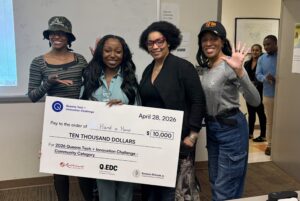
Months after winning $10,000 for a business Queens badly needs, Magdala Noel watched the Supreme Court clear a path to uproot the community she comes from.
A first-generation Haitian immigrant and a graduate of WIBO’s Queens cohort, Magdala is the founder of Hand in Hand Speech Therapy, a mobile, multilingual pediatric practice serving families across a borough where more than 300+ languages are spoken. Her work reaches children and addresses their individual needs in ways that larger providers cannot.
Earlier this year, Magdala took the stage at the Queens Tech and Innovation Challenge and walked off as the winner of a cash prize that will help grow her business and serve her community.
“By the time I stepped onto the QEDC stage, I wasn’t pitching a vision,” she said. “I was pitching a business with real numbers behind it. That’s because of WIBO.”
Those numbers were hard-won. Through WIBO Grow, our 16-week program, Magdala learned to price with intention, plan for profit, and read her own financials, the skills that turn a good idea into a business that lasts. She now applies the Rule of Thirds to every contract decision she makes.
Her story is bigger than one founder’s win. It sits at the center of a question New York cannot afford to ignore.
 This summer, a Supreme Court decision cleared the way to end Temporary Protected Status for roughly 350,000 Haitians, the community Magdala calls her own. The economic weight of that community is not abstract. Haitian TPS holders contribute close to $6 billion to the U.S. economy each year, according to research compiled by FWD.us, and New York’s roughly 40,000 Haitian TPS holders add more than $1.1 billion annually to the regional economy alone. Immigrants like them start businesses at a higher rate than U.S.-born residents, the American Immigration Council reports. Behind those figures are business owners, employees, taxpayers, and neighbors. They are people who, like Magdala, arrived here and built something that serves others.
When a community like that is put at risk, the loss is not only human. It is economic. Every founder who can no longer work legally is a payroll that stops, a service a neighborhood loses, a storefront that goes dark. Magdala’s practice alone reaches children across Queens who have nowhere else to turn. Multiply that by the thousands of Haitian-owned businesses across the city, and the stakes come into focus.
“Every time a multilingual practice gets recognized, it sends a message to the families we serve,” Magdala said. “Your child deserves an evaluator who speaks their language.”
That is what is on the line. Not a talking point, but the quiet, daily economics of people building businesses that hold neighborhoods together.
“Magdala is exactly the kind of entrepreneur this city was built by,” said Dr. Stacie N. C. Grant, Board Chair of WIBO. “When we invest in founders like her, we invest in jobs, in families, and in the future of the communities they serve.”
For 60 years, WIBO has bet on entrepreneurs the rest of the economy overlooked. Magdala Noel is why. Her business is proof of what one determined founder can build, and a reminder of what a city stands to lose when it stops making room for them.